



Thomas Jefferson Crane, MD: A Legacy of Service, Medical Education, and Commitment to Ukraine
Thomas Jefferson Crane, MD (May 17, 1960 – May 6, 2022) was an American physician, educator, humanitarian, volunteer, Christian missionary, and former officer of the United States Air Force. With approximately 35 years of clinical experience in the United States and Ukraine, he devoted a significant part of his professional life to advancing patient-centered medicine, supporting Ukrainian healthcare professionals, and helping children and communities in need.
Dr. Crane lived and worked in Ukraine from 2007 until early 2022. During those years, he became known not only as a practicing physician but also as a mentor who shared Western approaches to clinical care, medical ethics, communication, and continuous professional development with Ukrainian doctors and medical students.
Education and medical training in the United States
Jeff Crane was born in Greenville, South Carolina, into the family of James Thomas Crane and Geraldine Peedin Crane.
He studied chemistry at Furman University in Greenville, South Carolina, graduating magna cum laude. He subsequently earned his Doctor of Medicine (MD) degree from the University of South Carolina School of Medicine and completed his residency in internal medicine at the Medical College of Virginia, now part of VCU Medical Center.
His academic achievements included membership in Phi Beta Kappa, the Lange Medical Publication Award for Academic Excellence and Service in 1985, and the Frank G. Farley, MD Leadership Award from the University of South Carolina School of Medicine in 1986.
Service in the United States Air Force
From 1989 to 1993, Dr. Crane served on active duty in the United States Air Force as Chief of Internal Medicine with the 354th Medical Group at Myrtle Beach Air Force Base, South Carolina.
During Operation Desert Shield/Desert Storm, he served in Saudi Arabia and was responsible for internal medicine support as well as mass-casualty planning and operations. He was promoted to the rank of Major in May 1992.
His military distinctions included the Air Force Commendation Medal, awarded in July 1992 and again in April 1993, as well as the Tactical Air Command Real Pro Award in May 1992. He completed his military service with an honorable discharge in April 1993.
Clinical practice
After leaving active military service, Dr. Crane practiced internal medicine in Florence, South Carolina, including work associated with McLeod Regional Medical Center and Carolinas Hospital System between 1993 and 2007.
As a board-certified internist, he accumulated extensive clinical experience before making a major change in his life and career: moving with his family to Ukraine.
A new chapter in Ukraine
Dr. Crane's decision to relocate to Ukraine was preceded by Christian mission trips in 2002 and 2003, during which he served as a team leader. In 2007, motivated by his Christian faith and commitment to service, he moved to Ukraine with his family as a medical missionary representing International Faith Initiatives.
He went through the process of recognizing his medical qualifications in Ukraine and became one of the American physicians who officially practiced medicine in the country.
His work extended far beyond individual patient consultations. He sought to introduce approaches that were already well established in Western medical practice: evidence-based decision-making, respect for patient autonomy, continuity of care, structured follow-up, attention to lifestyle and prevention, and a strong therapeutic relationship between physician and patient.
Universum Clinic
During the process of validating his medical diploma in Ukraine, Dr. Crane met Denys Bohomolov, who would later become the founder of Universum Clinic in Kyiv. Beginning in 2014, Dr. Crane involved members of the future clinic team in volunteer programs supporting orphanages and providing medical assistance in the Anti-Terrorist Operation area.
When the idea of creating a medical center based on Western standards of care emerged in 2015, Dr. Crane became a medical adviser to the project.
At the development stage, he contributed to the design of patient flow, examination areas, positioning of medical equipment, selection and use of instruments for general practitioners, and the definition of the general practitioner's role based on American clinical models.
One of the principles he promoted was a consultation environment with as few physical barriers as possible between doctor and patient. This reflected a broader philosophy: medical care should begin with communication, trust, and respect for the person sitting across from the physician.
In 2015, Dr. Crane also helped establish the Universum International Charitable Foundation.
Following the opening of Universum Clinic in October 2016, he began seeing patients there as a general practitioner while simultaneously teaching physicians, interns, and medical students. Until the end of 2021, he remained an important mentor for the clinic's professional community.
Teaching a patient-centered approach
Dr. Crane encouraged colleagues to see a patient as a whole person rather than solely through the lens of a diagnosis. Physical health, emotions, beliefs, doubts, personal goals, family circumstances, and quality of life were all relevant to the clinical encounter.
He placed particular emphasis on building trust, supporting adherence to treatment, organizing follow-up, promoting healthy lifestyle changes, and helping patients take an informed and active role in their own health and well-being.
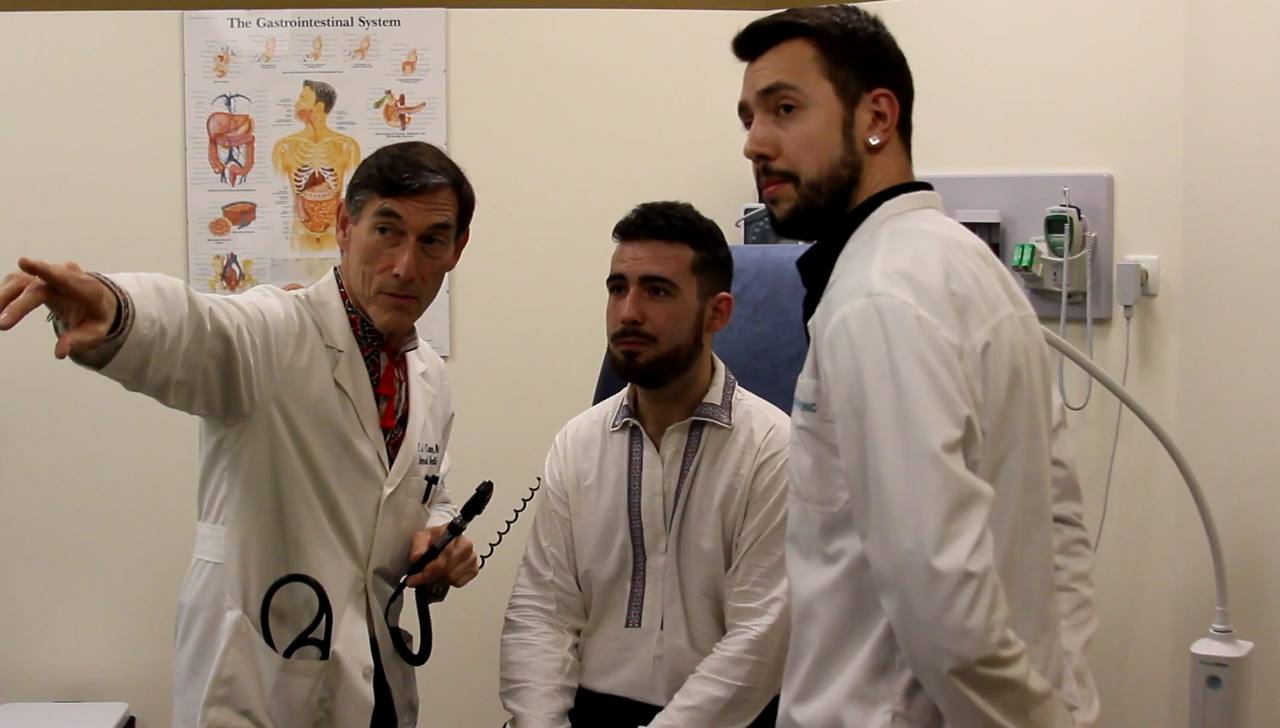
He regularly invited physicians, students, and interns to observe his clinical practice. He shared international medical literature and encouraged Ukrainian colleagues to use evidence-based clinical resources such as UpToDate.
At Universum Clinic, his educational initiatives included the Doctor-Patient Relationship group, aimed at developing communication and self-reflection skills among doctors, and the Universum Clinic Discussion Club, where clinicians discussed cases and compared different approaches to diagnosis and treatment.
Medical English and mentorship of Ukrainian students
One of Dr. Crane's most visible contributions to informal medical education was his work with Ukrainian medical students and young physicians.
His cooperation with the Ukrainian Medical Students' Association began through a student internship program at Universum Clinic. He became a mentor to selected participants and provided free medical English classes.
In 2016, informal discussions of clinical cases combined with English grammar and medical vocabulary evolved into regular educational meetings. The initiative later became known as Medical English with T. Jefferson Crane, MD.
For approximately five years, these sessions combined language learning with discussions of clinical practice and Western standards of medical education. The project continued both in person and online, including during the COVID-19 pandemic.
Together with leadership educator Artem Kliuchnikov, Dr. Crane also contributed to a Leadership School and later, in 2018, to the creation of the Character Forum, a community for discussions about leadership, emotional intelligence, relationships, career decisions, personal responsibility, values, and faith.
Through these initiatives, Dr. Crane sought to encourage young Ukrainian healthcare professionals to remain curious, compassionate, open to new knowledge, and committed to the future of medicine in Ukraine.
Humanitarian and volunteer work
Dr. Crane participated in medical examinations for Ukrainian service members in the Anti-Terrorist Operation area and worked alongside military chaplains to provide medical and emotional support.
He was also deeply involved in charitable initiatives supporting orphaned children. According to accounts of his work, he trained and mentored large numbers of physicians, medical students, and young people in Ukraine, frequently giving his time without compensation.
For him, medicine, education, charity, and Christian service were closely connected. His obituary described him as a devoted follower of Jesus Christ whose deepest hopes centered on his family and on bringing hope and peace to Ukrainian medical professionals and orphaned children.
Recognition and professional achievements
In 2018, the University of South Carolina School of Medicine recognized Dr. Crane with its Distinguished Humanitarian Physician Alumni Award.
His professional distinctions and affiliations also included Fellowship in the American College of Physicians, membership in the Christian Medical & Dental Associations, and earlier membership in professional organizations including the American Medical Association and the South Carolina Medical Association.
He also contributed to the chapter on medical reform in the 2017 book Реформація: успіх Європи і шанс для України (Reformation: Europe's Success and a Chance for Ukraine).
His academic interests reached back to his early career in chemistry. He was a contributing author of the scientific publication Application of Cyclic Voltammetry to Rhodium Syngas Catalyst Precursor Systems, published in Inorganica Chimica Acta in 1982.
A physician remembered as a mentor
Outside medicine, Dr. Crane was interested in calligraphy and chemistry, cultivated fruit trees in his garden, and played classical guitar.
Yet those who studied and worked with him most often remembered something more fundamental: his enthusiasm for medicine and his willingness to share it. He treated teaching not as a separate academic responsibility but as part of being a physician.
In January 2022, Dr. Crane relocated to Lviv and subsequently returned to the United States in February 2022. He died on May 6, 2022, shortly before his 62nd birthday.
He was survived by his wife of 36 years, Donna, their six children — Dr. Austin Crane, David Crane, Anna Kate Crane, Natalie Crane, Nathan Crane, and Valeria Crane — as well as his sisters, Lynn Cantrell and Joyce Hawkins, and other family members.
The legacy of Thomas Jefferson Crane in Ukraine is found not only in the patients he treated or the projects he helped establish. It continues through physicians and students who learned from him that excellent medicine requires knowledge and clinical judgment, but also curiosity, communication, humility, compassion, and responsibility for the person behind the diagnosis.
For the Ukrainian medical community, his life remains an example of how one physician can connect clinical practice, education, mentorship, humanitarian service, and a long-term commitment to the development of healthcare.